Stop Being Busy and Start Being Productive: Why the ABCDE Method is the Only To-Do List Hack You Need

Do you spend your workday “running around putting out fires,” only to realize at 5:00 PM that your most important projects haven’t moved an inch?
This state of perpetual motion without high impact is a common trap for high-achievers. We often feel productive because we are busy, but the reality is that we are falling victim to the Mere-Urgency Effect.
Psychological research indicates that our brains are naturally drawn to time-sensitive tasks over those that are less urgent, even when the non-urgent tasks offer much greater long-term rewards. We fixate on the clock rather than the payoff.
However, here is the strategist’s reality check: this psychological trap can be reversed. Studies show that when we are prompted to consider the consequences of our choices, we break the urgency spell and refocus on what actually matters.
The ABCDE Method is a simple but powerful tool for this reversal. It transforms a cluttered to-do list into a strategic roadmap by forcing you to look past the deadline and toward the impact.
The Mere-Urgency Effect: When Busy Feels Productive
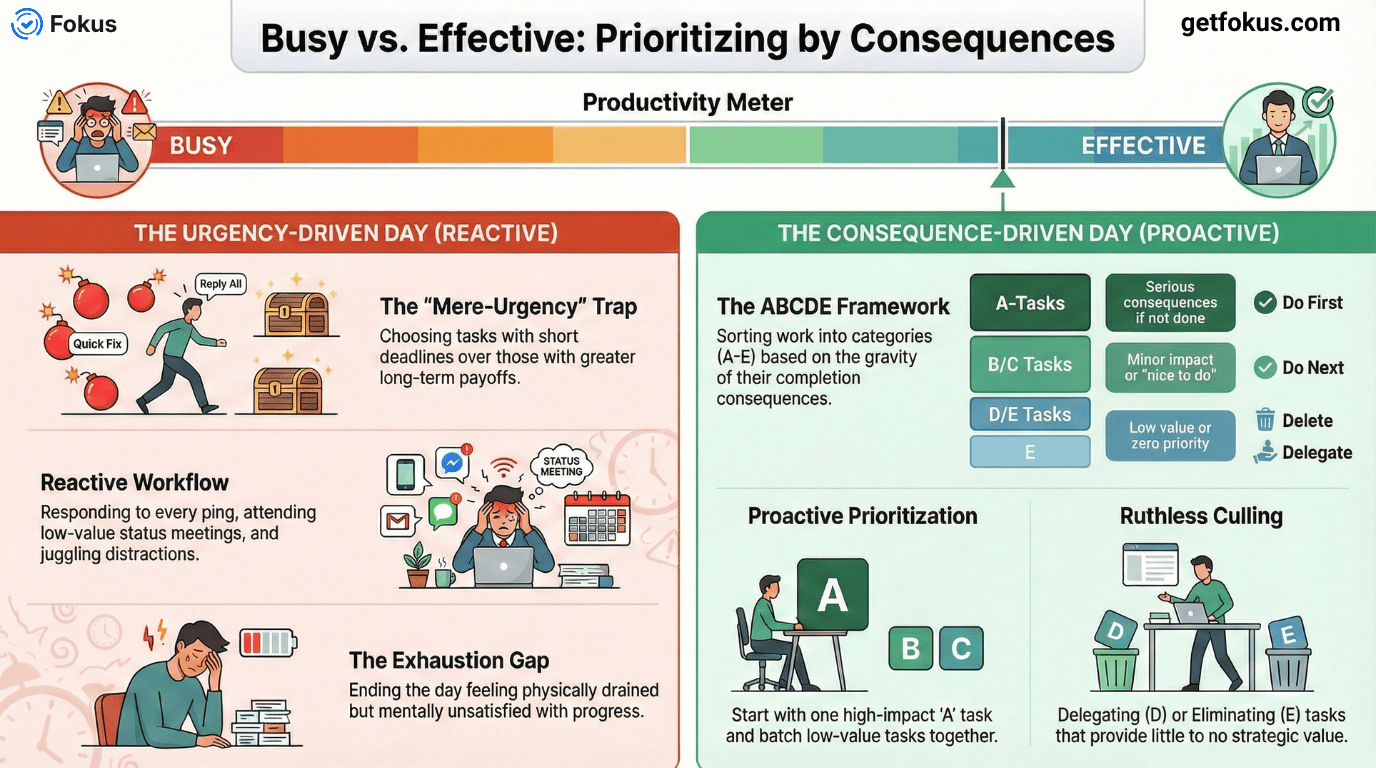
Most to-do lists are democratic: everything sits on the same level. Reply to a Slack message, draft a strategic roadmap, schedule a dentist appointment, refine a core product feature — all appear as equal items.
Your brain, however, does not treat them equally. Anything that feels urgent — usually because someone is waiting on you or a timer is ticking — gets your attention first, even when its long-term value is low.
The result:
- You end the day exhausted but strangely dissatisfied.
- Critical projects creep forward in inches instead of leaps.
- Your calendar is full, but your outcomes are flat.
The ABCDE method breaks this pattern by asking a different question: What are the consequences of not doing this task? Once you sort your list by consequences, not just urgency, urgency stops being the boss.
How the ABCDE Method Works
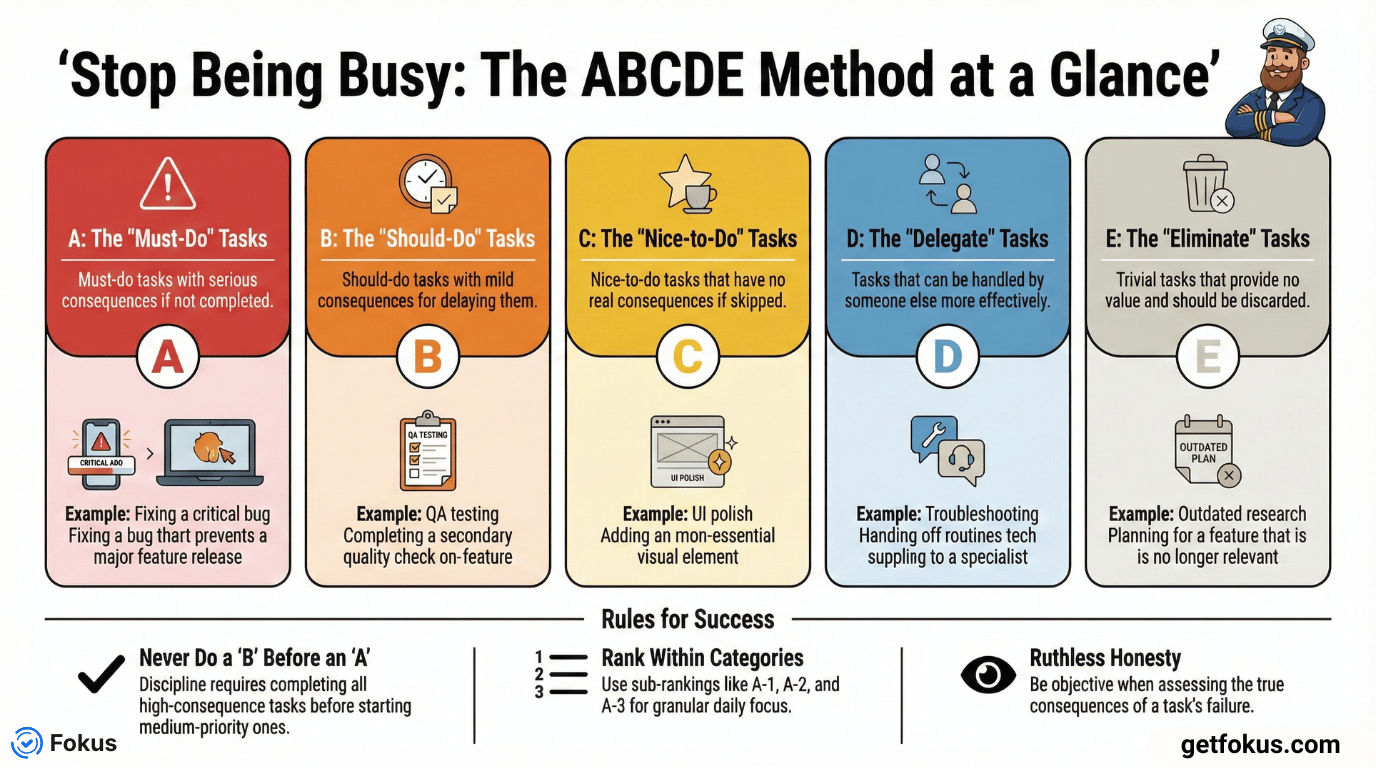
The ABCDE method takes your raw to-do list and assigns each item a letter based on its real strategic weight:
- A – Must do: serious consequences if neglected
- B – Should do: mild consequences if delayed
- C – Nice to do: no meaningful consequences
- D – Delegate: someone else should do this
- E – Eliminate: doesn’t need to be done at all
Once everything has a letter, you always work from A downward, never the other way around.
Your “A” Task is Your “Frog” — Eat It First
In the ABCDE framework, “A” tasks are your highest priority. These are what productivity expert Brian Tracy, referencing a famous Mark Twain analogy, calls your “frogs.”
An “A” task is something with serious consequences if not completed — like sending final visual designs for a major client campaign or finishing a report for a leadership team meeting.
We often procrastinate on “A” tasks because they require the most cognitive effort. To turn this method into a permanent behavior, you must apply the 3 Ds of New Habit Formation:
- Decision – Decide that completing your “A” task first is your new standard.
- Discipline – Commit to following the system even when it feels uncomfortable.
- Determination – Continue long enough for this to become second nature.
Completing these high-stakes tasks first ensures they are handled while you are at peak energy, rather than leaving them for the end of the day when your willpower is depleted.
“If you can start your morning by eating a live frog, you’d have tackled the worst thing that can happen that day.”
The Power of “E” — Ruthless Elimination is a Superpower
While most people focus on what to add to their lists, a master strategist knows that success is often defined by what you stop doing.
“E” stands for Eliminate. These are tasks with zero priority and zero urgency.
Research shows that a staggering 80% of the average workday is spent on tasks with little or no value. This is the 80/20 rule in its most destructive form.
To reclaim your time, you must engage in tactical pruning. “E” tasks are the distractions:
- Mindless social media scrolling “to take a break”
- Unnecessary status meetings with no clear decision or outcome
- Brainstorming new services you’ve already decided aren’t viable
Deleting these is not an act of avoidance; it is a deliberate strategic move to create the mental space required for deep, meaningful work.
Priority is Defined by Consequences, Not Just Deadlines
The ABCDE method shifts you from a reactive mindset to a proactive one by teaching you to weigh the severity of the consequence of not doing a task.
This is the cognitive shift required to reverse the Mere-Urgency Effect. By keeping the long-term importance in view, you override the brain’s impulse to grab the “nearest” task.
To maintain the integrity of your system, you must follow the cardinal rule:
Never do a “B” task when an “A” task is left undone.
A quick reference:
- A Tasks: High-value items with serious consequences (e.g., sending final campaign designs).
- B Tasks: Important items with milder consequences for delay (e.g., reviewing mockups for a project due in three weeks).
- C Tasks: “Nice to do” items with no real pressure (e.g., an internal process improvement idea).
By strictly categorizing your list this way, you ensure that your energy is spent on activities that move the needle for your business, rather than just “working about work.”
Mastering “D” — Delegation as a Tool for Focus
The “D” in the ABCDE method stands for Delegate. These are tasks that may be urgent but do not require your specific expertise or unique skill set.
A common pitfall for leaders is the micromanagement attitude — the belief that you must do everything yourself to ensure it is done correctly.
In reality, delegation is an essential tool for focus. You should delegate any task that:
- Someone on your team is more qualified to handle, or
- Does not directly contribute to your long-term goals.
For example, software troubleshooting is a “D” task that should be handled by the tech team, freeing you to remain laser-focused on your “A” objectives.
When you delegate effectively, you:
- Free up your own time for high-leverage work
- Empower your team to grow their skills and ownership
- Reduce context switching and decision fatigue
Synergizing ABCDE with Your Biological Prime Time
To achieve a true return on energy, you must synchronize your ABCDE list with your Biological Prime Time (BPT).
Your BPT is the specific window when your focus reaches its highest peak on a 0–5 energy scale.
Matching your “A” task with your highest energy level is the ultimate productivity hack. If you attempt to “eat your frog” during an energy trough, you will likely succumb to distraction.
Typical patterns:
- Early Birds: Often peak in the morning and should hit “A” tasks immediately.
- Mid-Day Peak: Many people find their BPT around late morning or noon; save your most complex analysis for this window.
- Night Owls: Often experience a “second wind” in the early evening.
“Biological prime time (BPT) refers to when you have the most energy or feel you are most productive in accomplishing your tasks.”
Design your day so that:
- “A” tasks sit inside your BPT
- “B” tasks fill the next-best energy windows
- “C”, “D”, and “E” tasks are batched, delegated, or deleted
Conclusion: The Forward-Looking Summary
The ABCDE method is not just a list technique; it is the “Organize” and “Prioritize” phase of a comprehensive workflow.
By integrating it with the “Capture” and “Clarify” pillars of methodologies like Getting Things Done (GTD), you move toward a state of stress-free productivity.
When you stop reacting to the loudest deadline and start commanding your day based on consequences, you stop being busy and start being effective.
If you looked at your to-do list right now, how much of your day is spent eating frogs, and how much is spent just tending to the noise?